A 4.4 Mile Swim in open water may seem daunting, in fact, it did for me up until the event began. As shortly as 3 weeks before I was approximating myself as having less than a 50% chance of completion. There’s a long list of reasons for this that I’ll get into throughout this article series, but at the most basic level, 4.4 miles is a long way to swim. This was my second-ever open water swim, with the 2025 Chesapeake Bay 1-Mile Swim being my first (you can read more about that here). But over the last few weeks of training my confidence grew and ultimately I finished the swim comfortably and with enough confidence to return to next year’s swim optimistic about how I might perform.
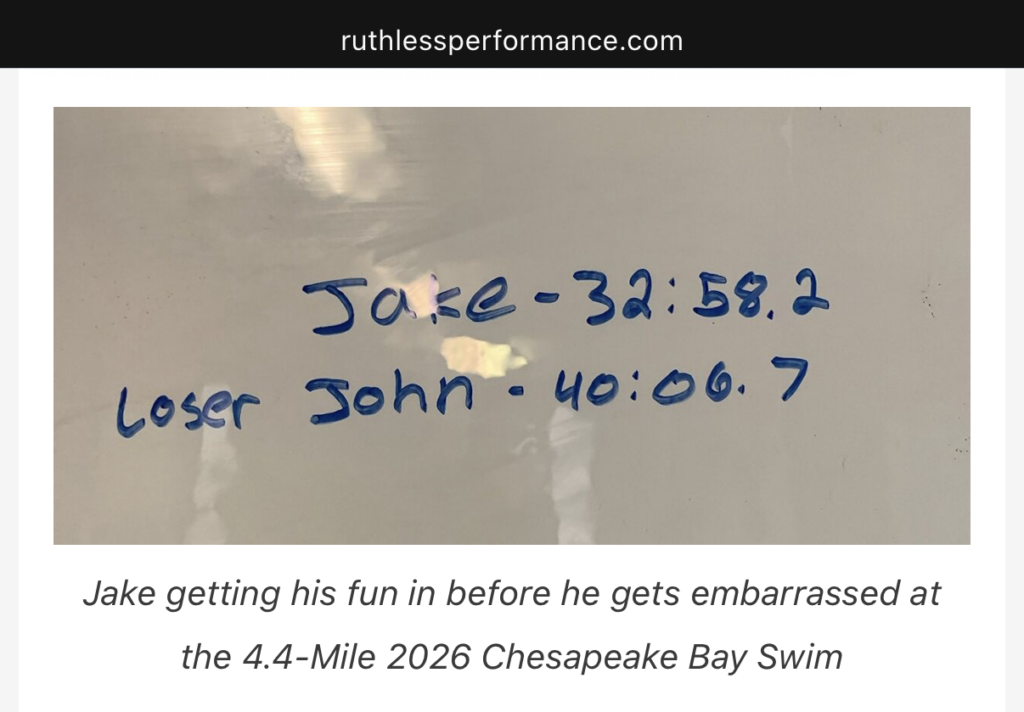
Leading into last year’s 1-mile event, my primary training mechanism was smack-talking fellow Ruthless Performance Coach Jake Hillibush about how I was going to beat him, then, come race day, hope for the best. But that was only a mile and an easy opportunity to get wet and throw my hat into the open-water realm, alongside Jake who was also participating in his first competitive open water swim.
Last year I thought “Sure, Jake is a college-level swimmer, but its our first open water swim so anything could happen”. Leaving me with a very real sense that I may actually be able to live up to all of my smack-talking about how I could beat Jake.
Sadly, I did not.
This year, however, I thought more favorably of how Jake might perform. Afterall, I thought, “Jake is a college-level swimmer who still holds an impressive PIAA District 11 Meet Record in the 100 Breaststroke… Who am I kidding to think that I could even come close to keeping up for a 4.4-mile swim”. And with that, I didn’t think much about beating Jake this year until after I pulled myself past the finish line and Jake’s parents asked with some concern “Where’s Jake?”
I was quite pleased with myself in that moment.
My primary goal for the swim this year was simply to finish. Since the event has cutoffs at the various mile markers, gritting my teeth and grinding it out for an excessive amount of time wasn’t a real option. I had to swim the full-length and meet or exceed a time threshold at each of the markers or have an embarrassing boat ride back to shore.
Ultimately, Jake and I completed the event, and I came away feeling more confident in my open water swimming abilities and with some new tips and strategies that anyone could use to complete their first open water swim, or even to improve their standing as a competitive open water swimmer.
So let’s dig in…
Training
In-Water
Traditional, high-yardage swimmers and coaches are going to hate to hear this part so I’ll lead this section off with this and get it out of the way. My in-water training volume in 2026 for this 4.4 Mile Swim was a grand total of 3 Miles.
Yep, you read that right.
Having the Great Chesapeake Bay Swim in early June is great for kicking off my somewhat competitive endurance sports season (4.4 Mile Open Water Swim early June, Ben to the Shore 65-Mile Bike Tour from Philadelphia to Atlantic City in late July, then wrapping up the summer with a 28-Mile March for the Fallen ruck with a 35 lb. pack in September). But this early June timeline makes spring training in the open water somewhat logistically challenging.
My pool training consisted of 3 separate relatively short workouts. The first two sessions were a grand total of a pool mile (1650 yds.), broken up into 16×100, a 25 sprint, and a 25 yd. float as a cool down. Since I have a sprinter’s disposition (dumb but good reflexes), I typically can’t even count to 16 or to that many 100’s. My strategy to keep track was to bring 16 kickboards to my lane and swap the kickboards into a new pile after each 100 yd segment. This strategy generated some odd looks during open swim but it kept me from screwing up my sets as I’ve long had a tendency to do.
Workout #3 was a timed mile. Here, Jake and I both got in to see how we held up in a 1-mile swim and if we thought it was feasible to hold our goal paces in the open water.
Since my schedule didn’t align all that well with pool time, my training was limited and I had about 45 minutes in the water design my pool workouts around. These 3 workouts had no warm up other than building into the 100’s.
I did have a fourth “Sprint” workout, two days after my timed mile, which was the Tankmen II, an alumni swim meet where I swam the 50 Free, 50 Fly, and 50 Breast. I did warm up prior to the meet, so my total training volume might be 400 yards or so over 3-miles for 2026.
If I was treating this event truly competitively, my in-water training volume would surely be higher, although not much more. I would still target pacing goals for 1-mile test sets, but I doubt my overall training volume in the pool would get higher than 2-miles in a single session.
Land-Based Training
Strength Training
Where I do excel, however, and what allows me to spend such little time in the pool while being somewhat prepared for completing an event like this, is my training style outside of the pool. Our training style at Ruthless Performance works synergistically with sport-specific training even with high-yardage athletes. The way we train each athlete varies as much as the athletes themselves vary, here, I’m just using this article to elaborate on my own training which is built for my own schedule, my own preferences, and my own needs–just as all of our programs are built to suit each of our different athletes across various sports and pursuits.
My typical strength training split is a 4-day split consisting of alternating upper-body dominant and lower-body dominant workouts. My training did vary for the first half of the year, but to break it down a typical workout would consist of a few activation drills, some mobility, and selective stretching. Then, onto some type of speed work like push presses, box jumps, olympic lifts, or various plyometric exercises. My main lifts would be next. This is what the four day split is matched to: a squat day, a horizontal press day (i.e. floor press, bench, or push-up type lifts), a hinge day (i.e. deadlift, trapbar deadlift), and a vertical press day (i.e. overhead barbell press).
After the main lift, I would do 3-4 accessory lifts for 2-3 sets, depending on the day, and what time would allow for. Wrapping it all up, I may do a quick tabata, some type of exercise for as many reps as possible, or a prescribed amount of reps as quickly as possible (i.e. Toes to Bar for 25 reps as few sets as possible).
Then always a pull up bar hang for my cool down along with 1-2 other stretches or repeating mobility drills from the warm up.
Weekly Totals
I’ll take the easy way out and blame this part on parenthood. As a parent, plus business ownership, and whatever else, my large chunks of time to dedicate to workouts is a fraction of what time would’ve allowed for in college. This is one of the first events where my weekly totals style of training really came to the forefront as a means to get in serious training throughout the day rather than all at once.
During my spring training and lead up to this swim, my strength training sessions were actually cut back in volume. This accessory training volume was increased overall by taking a chunk of my accessory lifts and simply completing a set total amount of reps throughout the week (i.e. 150 Kettlebell Swings, 60 Chin-Ups, 150 Hollow Body Rocks, etc.).
Read more about my weekly totals concept here.
Cardiovascular Training
My dryland / strength training regimen started off the year strong and continued very closely up until the swim itself. Though as the swim grew near, my overall cardio / energy system training became much more dominant in my training program, albeit not much in the pool (did I mention that I only swam 3 miles in 2026?). Primarily because of logistical constraints around securing pool time, my predominant cardiovascular training was on my bike, with a healthy dose of running sprinkled into the mix.
Even outside of the pool, my cardio workouts were typically not all that lengthy. Almost all of my training runs were 3.5 miles or shorter and most of my cycling workouts were a 4.85 mile sprint loop.
But these workouts did get longer and as the swim got closer there was more and more of them.
Two weeks prior to the swim my cardio training peaked with 5 separate energy system training sessions. These workouts included a 2x 3.5 Mile Trail Runs, 1×25 Mile Cycle, 1×1 Mile Swim, and 1×110 Mile Cycle.
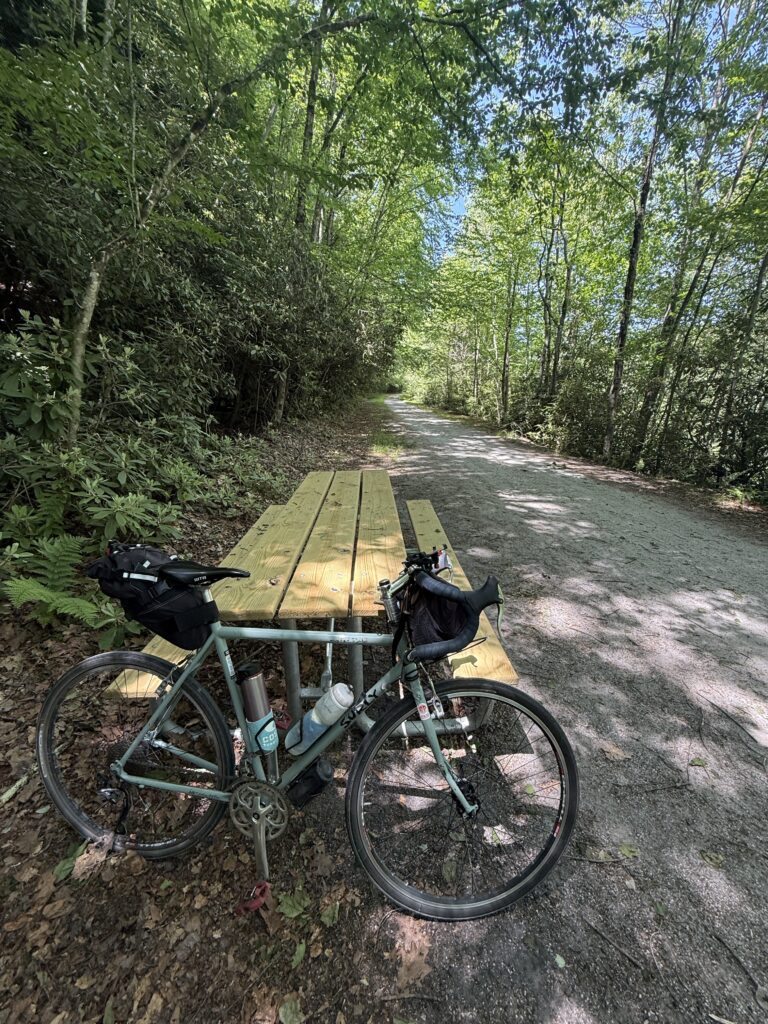
The 110-Mile Cycle deserves some comment since it is, by far, the lengthiest and most challenging part of my endurance training for this event. Talk about cramming… I knew that coming into to home stretch of training that I needed a final coup de gras in my training to put me over the edge and have more experience the not-so-fun-zone of long distance endurance events. Though not specific to swimming, this workout was designed to essentially build my stress tolerance over a long duration workout. This took my 10 Hours and 35 Minutes, 8 Hours and 51 Minutes moving time, with 4,461 feet of climbing.
Recovery Workout
In the final week, I tapered out my training to allow for a pretty full recovery. With the swim on Sunday, I completed my last ‘recovery’ workout midday Friday. Here’s my exact recovery workout from June 12:
6/12/26 Recovery Workout
- 2x
- Lateral Band Walk x10 ea.
- 90/90 Hip Switch with Hip Extension x6 ea.
- Half Kneeling Shoulder External Rotation x15 ea.
- 5x
- Band Pull Apart x25
- Weighted Hang x:30
- Quadruped T-Spine Rotation x5 ea.
- 3x
- Pec SMR w/ Beastie Ball x:20 ea.
- Swiss Ball Stir the Pot x5 ea.
- Incline Bench Supported ‘Y’ Raise x15
- 2x
- Couch Stretch x:30 ea.
- Tucked Lat Stretch Walk x5 ea. (w/ :03 Pause)
Also during this workout I recorded my bodyweight at 174.6 lb. on our calibrated scale at the gym. This was down about 4 pounds from where I was sitting in the spring.
Nutrition
I’m not going to get into my exact nutrition strategy for the race–its just too complicated and beyond the scope of this already lengthy article. I do, however, have my receipt from the grocery store that I stopped at as I made my way to the Chesapeake the day before the swim.
I didn’t eat all of this but this is the list from my receipt of foods that I got which I wanted to make sure I had access to the night or morning before the swim, and even as a recovery aid after the swim:
- 1x 0.81 lb. mixed cup of Kiwis and Strawberries
- 3x Organic Grapefruits
- 3x Organic Fuji Apples
- 4x Painterland Sisters Skyr
- 1x .45 lb. Bulk Organic Salted Mixed Nuts (Walnut, Almond, Pecan)
- 1x 15.5 Oz Yerba Mate Mint Tea
- 5x Canned Kombuchas
- 3x Canned Nitro Cold Brews
- 3x Organic Bananas
Time to Swim…
I grow weary as I write this, as I’m sure you do of reading it. Although I’m sure reading about my shopping list was enticing and engaging to you as a reader. I’ll break this off here and come back with another installment that goes into detail on my gear for the swim (swimmers care more about gear than they do nutrition and training although perhaps the opposite should be the case). I’ll also talk about the [very early] morning of the swim, the swim itself, and some of my broader takeaways.
So I’ll leave that as a dangling carrot for the next part.
-John